3 October 2026 · Green Queen Cleaning
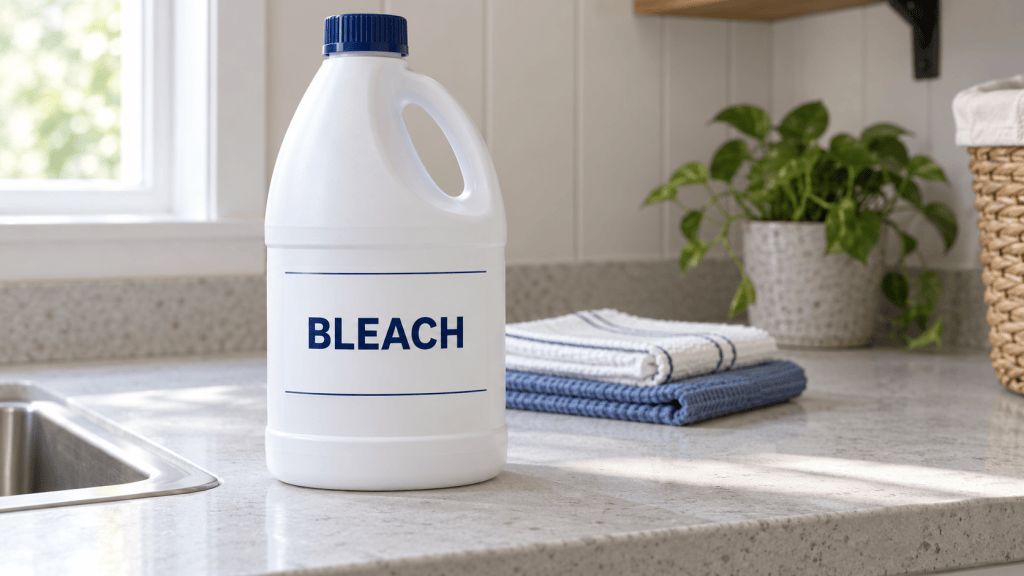
A clean home should feel welcoming. Bleach is a familiar disinfectant, but it is worth thinking about when we actually need it, how we handle it and what happens after use. Choosing a suitable product and using only the amount required can make everyday cleaning more thoughtful.
What is household bleach?
Most chlorine bleach contains sodium hypochlorite. It can disinfect and remove stains, and it has important uses in infection control and water treatment. That does not mean every surface needs bleach during every clean.
Our health: handling matters
Bleach can irritate skin and eyes; stronger solutions can cause burns. Mixing it with acidic cleaners, including vinegar and some toilet cleaners, can release chlorine gas. Ammonia-containing products can produce irritating chloramines. Never mix bleach with other cleaning products. Follow the label, ventilate the room and use the protective equipment specified. Keep it in its original container, securely away from children and pets. UKHSA explains these exposure risks.
The science: by-products in household bleach
Bleach does not act only on germs. Sodium hypochlorite can also react with organic ingredients in a cleaning product and with material on the surfaces being cleaned, creating new chlorinated compounds. Researchers have investigated these reactions in domestic products as well as in industrial settings.
A 2008 study analysed chlorine-bleach-containing household products and measured indoor air during bathroom cleaning. It identified compounds including chloroform and carbon tetrachloride, and found that their indoor concentrations increased during use. The researchers also detected volatile compounds in the air above the products themselves. This shows why product formulation and ventilation matter, including when products are stored and used at home. It does not mean that every bottle or every cleaning session produces the same exposure. Odabasi, Environmental Science & Technology, 2008.
What happens when bleach reaches wastewater?
Chlorine can react with organic matter in wastewater to form organohalogen by-products. An OSPAR review of household hypochlorite use discusses this chemistry and identifies compounds such as chloroform and chlorinated acids. Treatment can remove or break down a substantial proportion of these substances, so the amount formed is not the same as the amount eventually released into a river.
The type and quantity of by-products depend on the product, the organic material present and treatment conditions. Older studies did not identify every compound in the mixture. That uncertainty warrants careful product use, but it does not establish that all of the unidentified compounds are dioxins. The OSPAR review specifically reports that household hypochlorite use does not form dioxins. OSPAR: Background Document on the Use of Sodium Hypochlorite, 1999.
Waterways and aquatic life
Sodium hypochlorite is hazardous to aquatic organisms at sufficient concentrations. Preventing spills and avoiding direct release into waterways matters. Its active chlorine is highly reactive and breaks down rapidly, so its environmental behaviour differs from that of pollutants that remain unchanged for years. Concentration, reactions and the route of release all affect the risk. Follow the product’s disposal instructions and local waste guidance; do not pour unwanted concentrated product into outdoor drains. ECHA’s assessment discusses aquatic hazards and rapid degradation.
What about the food chain?
Dioxins are a group of highly toxic, persistent pollutants. The term includes polychlorinated dibenzo-p-dioxins (PCDDs), polychlorinated dibenzofurans (PCDFs) and certain dioxin-like PCBs. They can accumulate in animal fat and move through the food chain; the World Health Organization says more than 90% of human exposure comes through food, particularly meat, dairy, fish and shellfish. Long-term exposure can affect hormonal, immune and reproductive systems, and TCDD is classified as a human carcinogen. Risk depends on the amount and duration of exposure. WHO says normal background exposure is not expected to affect health on average, while still recommending efforts to reduce it. These concerns mainly relate to sources such as industrial processes and uncontrolled waste burning. They should not be presented as proof that ordinary domestic bleach use generates dioxins. WHO: dioxins and their effects on human health.
A practical approach to everyday cleaning
Cleaning removes dirt and germs; disinfecting is a separate step. For many everyday household tasks, a suitable detergent, water and thorough wiping are enough. Extra disinfection may be needed when someone is ill or where particular infection risks apply. Choose a product intended for the task and follow its dilution and contact-time instructions. An eco label, an essential oil or a pleasant scent does not by itself prove that a product disinfects. CDC guidance explains when cleaning and disinfection are needed.
Alternatives we can choose in our own homes
We cannot control every industrial source of pollution, but we can decide what we use for everyday domestic cleaning. Start with the task: a suitable detergent for kitchen grease, a surface-compatible limescale remover for bathroom deposits, and regular wiping, brushing and rinsing. Bleach does not need to be the default product for every room.
Where disinfection is genuinely needed, choose a product with tested disinfectant claims for that use. A formulated hydrogen-peroxide-based disinfectant can be an option, provided it is suitable for the surface and used exactly as directed. Hydrogen peroxide is a different chemical from chlorine bleach; it is not automatically harmless or interchangeable with an everyday cleaner. Never add essential oils or mix products to create your own disinfectant.
Using the correct dose, keeping rooms ventilated and choosing fragrance-free products where preferred are practical habits we can adopt now. At Green Queen Cleaning, I discuss your priorities and select products for the specific job rather than adding unnecessary chemicals to every clean.
The Green Queen Cleaning approach
For routine home cleaning in Cardiff, I select products to suit the surface, the task and your household’s preferences. Fragrance-free options are available, and product choices are discussed before the visit. Careful dosing, reusable cloths and a clear cleaning plan help avoid unnecessary product use while maintaining a thorough finish.
Small, informed choices are a useful place to start. Explore why eco cleaning matters, or get in touch about your home.


Leave a comment